Anthropic Study Finds Limited Early AI Impact on US Labor Market
Published Cached
-
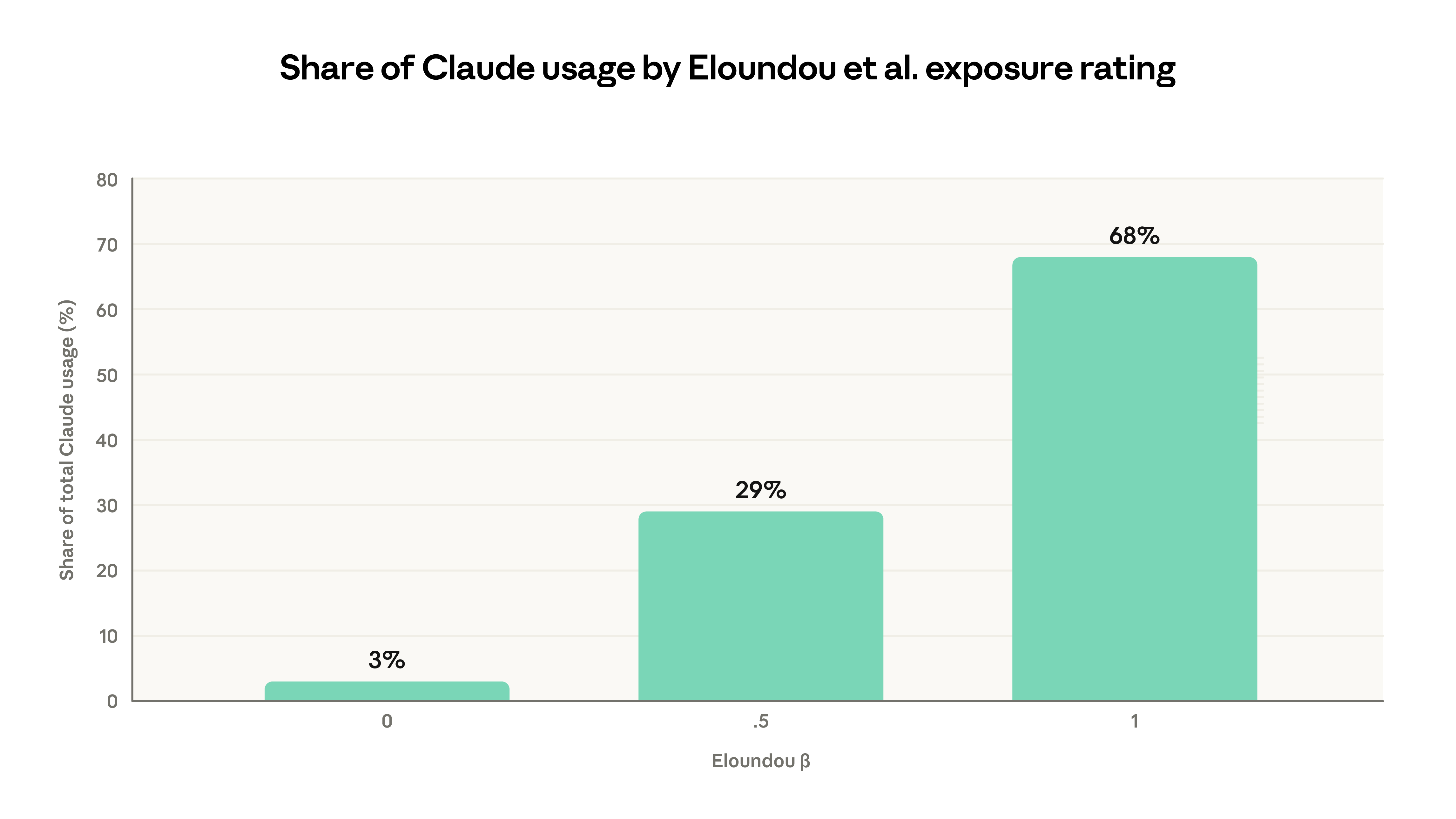 Image: AnthropicFigure 1: Share of Claude usage by Eloundou et al. task exposure ratingThis figure shows Claude usage distributed across O*NET tasks grouped by their theoretical AI exposure. Tasks rated β=1 (fully feasible for an LLM alone) account for 68% of observed Claude usage, while tasks rated β=0 (not feasible) account for just 3%. Data on Claude usage comes from the previous four Economic Index reports. (Anthropic) Source Full size
Observed exposure metric blends AI capability with real usage – The report introduces “observed exposure,” a new measure that combines theoretical task‑level LLM feasibility (from Eloundou et al.) with actual work‑related Claude usage data from the Anthropic Economic Index, weighting automated implementations more heavily than augmentative ones [1][3].
AI coverage remains far below theoretical potential – Across occupational categories, Claude automates only a fraction of tasks; for example, 33% of Computer & Math tasks are covered and programmers show 75% coverage, while many jobs have zero coverage, indicating AI has not yet reached its feasible scope [1][3][4].
Higher exposure correlates with modestly weaker job growth forecasts – A regression using 2025 BLS projections (2024‑2034) shows that each 10‑point rise in observed exposure reduces projected employment growth by 0.6 percentage points, a slight but statistically observable relationship not seen with the theoretical β metric alone [5][1].
Exposed workers tend to be older, female, and higher‑paid – Analysis of CPS data reveals that workers in the top quartile of exposure are 16 points more likely to be female, earn 47% more on average, and hold higher education levels compared with the 30% with zero exposure [1][7].
Unemployment rates for exposed occupations have not risen – Difference‑in‑differences estimates from 2016‑2024 show the unemployment gap between highly exposed and unexposed workers is small and statistically indistinguishable from zero since the release of ChatGPT, suggesting no clear AI‑driven job loss yet [1][8].
Job‑finding for young workers in exposed roles has slipped – Among 22‑25‑year‑olds, the monthly job‑finding rate into high‑exposure occupations fell by about 0.5 percentage points post‑ChatGPT, a 14% decline that is barely significant, while rates for less‑exposed jobs stayed near 2% per month [1][7].
Links
- [1] https://www.anthropic.com/research/labor-market-impacts
- [10] https://budgetlab.yale.edu
- [11] https://papers.ssrn.com/sol3/papers.cfm?abstract_id=3777307
- [12] https://eig.org/ai-and-jobs-the-final-word/
- [13] https://cdn.sanity.io/files/4zrzovbb/website/e5f77fc0e77c0185110b5e4b909602791ae76eae.pdf
- [14] https://eig.org/ai-and-jobs-the-final-word/
- [15] https://cdn.sanity.io/files/4zrzovbb/website/e5f77fc0e77c0185110b5e4b909602791ae76eae.pdf
- [2] https://www.onetcenter.org/database.html
- [3] https://www.anthropic.com/economic-index
- [4] https://cdn.sanity.io/files/4zrzovbb/website/e5f77fc0e77c0185110b5e4b909602791ae76eae.pdf
- [5] https://data.bls.gov/projections/occupationProj
- [6] https://cdn.sanity.io/files/4zrzovbb/website/e5f77fc0e77c0185110b5e4b909602791ae76eae.pdf
- [7] https://cdn.sanity.io/files/4zrzovbb/website/e5f77fc0e77c0185110b5e4b909602791ae76eae.pdf
- [8] https://eig.org/ai-and-jobs-the-final-word/
- [9] https://ssrn.com/abstract=5962594